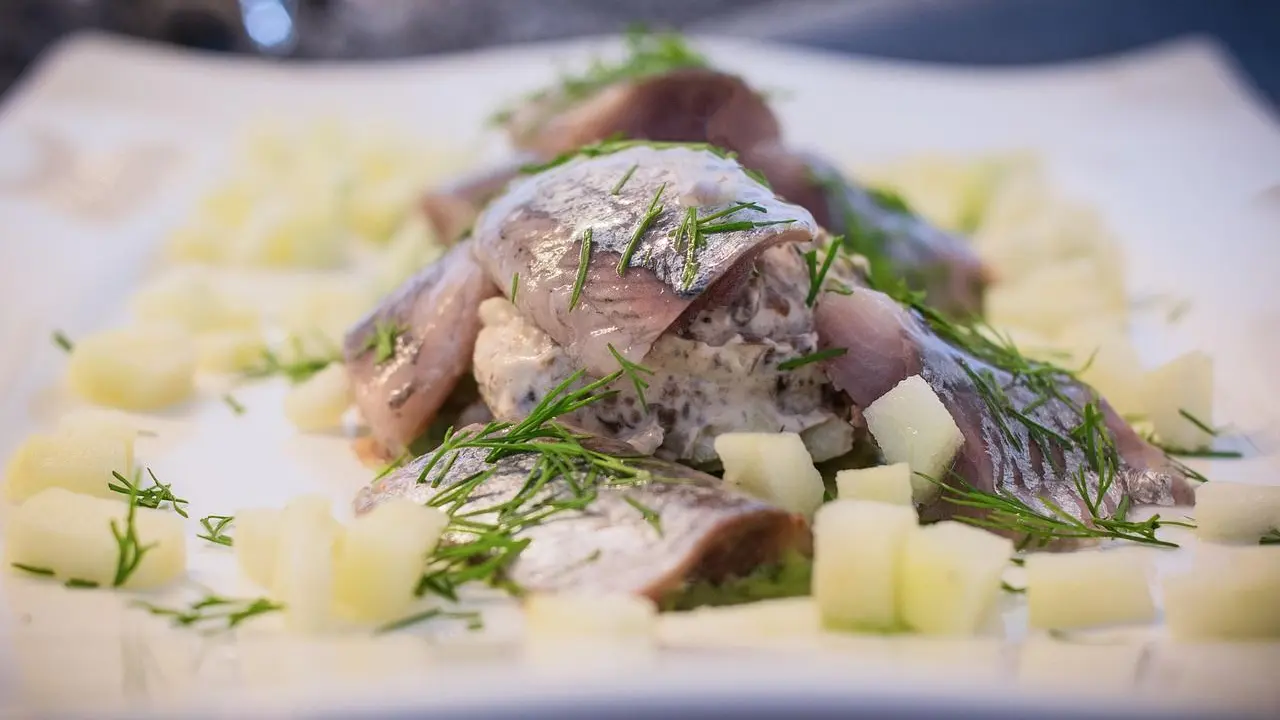
Want a matjes herring recipe you can trust? Buy good fillets, slice an onion and boil potatoes in their skins. Matjes needs no cooking or soaking, so the serving is the recipe.
If you enjoy this one, the wider range of seafood recipes has more ideas for the table.
| Item | Value |
|---|---|
| Catch season for Hollandse maatjesharing | 1 May to 31 August |
| Sale window for the name “Hollandse Nieuwe” | 1 May to 30 September, same year |
| Brining time | Approximately five days |
| EU freezing rule against Anisakis nematodes | -20 °C for at least 24 hours |
| Salt content of salt herring (needs soaking) | 20% |
The figures come from the EU product specification for Hollandse maatjesharing and from Wikipedia’s soused herring entry. They can change, so check the source before you rely on them.
What is matjes herring?
The EU specification for the Dutch version describes matjes as young, immature herring that is gibbed or headed, then brined or dry-salted. It can be eaten once natural enzymatic ripening has taken place, as set out in the product specification.
The name hints at the fish’s age. The same specification says maatje is a corruption of “maagdje” (virgin), because no roe or milt has formed by the time the herring is caught.
Enzymes do the rest of the work. Wikipedia’s entry says the liver and pancreas stay in the fish during salt-curing because they release enzymes essential for flavour, which makes this herring especially mild and soft.
The specification lists these traits for the Dutch product:
- White flesh.
- Meat of tender and fatty consistency.
- A creamy, slightly salty, delicate taste.
That rich, gentle character is why matjes is usually served simply, with something sharp, fresh or starchy beside it.
Matjes, Hollandse Nieuwe and the protected name
The specification protects the traditional product caught from 1 May to 31 August. It adds that “Hollandse maatjesharing” may be sold under that name either before or after 31 August of the fishing season, per the EU specification.
“Hollandse Nieuwe” is the narrower term. The same document says it may be sold under that name between 1 May and 30 September of the same calendar year.
As of the GOV.UK register entry published 4 January 2021, the name has the status Registered as a Traditional Speciality Guaranteed (TSG). The same entry gives 1 October 2015 as the date of original registration with the EU.
A Dutch fish wholesaler’s knowledge base says new herring has a fat percentage of at least 16%. It also reports that in 2020 no less than 50% of the Hollandse Nieuwe went to Germany, so the product is a familiar sight there.
How to buy and check matjes herring
Good matjes is easy to judge by eye. The soused herrings are silvery outside and pink inside when fresh, and Wikipedia says they should not be bought if they appear grey and oily, as noted on the soused herring page.
Fillets are the friendly choice for a first try. The same page says skin removal requires experience, so fillets or double fillets should be attempted first.
At the counter, check three things:
- The colour: silvery skin and pink flesh, not grey or oily.
- The cut: fillets or double fillets if you are new to skinning herring.
- The type: ask whether it is mild soused matjes or a saltier cure.
The last point matters. Wikipedia says salt herrings have a salt content of 20% and must be soaked in water before eating, while soused herrings do not need soaking, per the same entry.
Frozen fish is normal here. The entry notes that EU regulations state fish should be frozen at -20 °C for at least 24 hours to protect against Anisakis nematodes, so soused herring can be produced throughout the year.
A simple matjes herring recipe at home
This is an assembly recipe in the northern German style. It sets no fixed quantities: slice and boil for the number of people at your table.
- Choose fillets or double fillets and keep them chilled until you serve.
- Boil potatoes in their skins until tender, then keep them warm.
- Slice a raw onion as finely as you can, and slice some gherkins or pickles.
- Optional: cook French beans, and fry finely sliced bacon with onion.
- Lay the fillets on a platter with the onion and pickles. Soused herring needs no soaking.
- Serve with the potatoes, and put a cream or yogurt sauce with onions and gherkins on the side.
The onion has a history. A Dutch wholesaler’s explanation says herring used to be much saltier, which is why it was eaten with a chopped onion. The habit stayed, and the herring is also often eaten with pickles or completely natural.
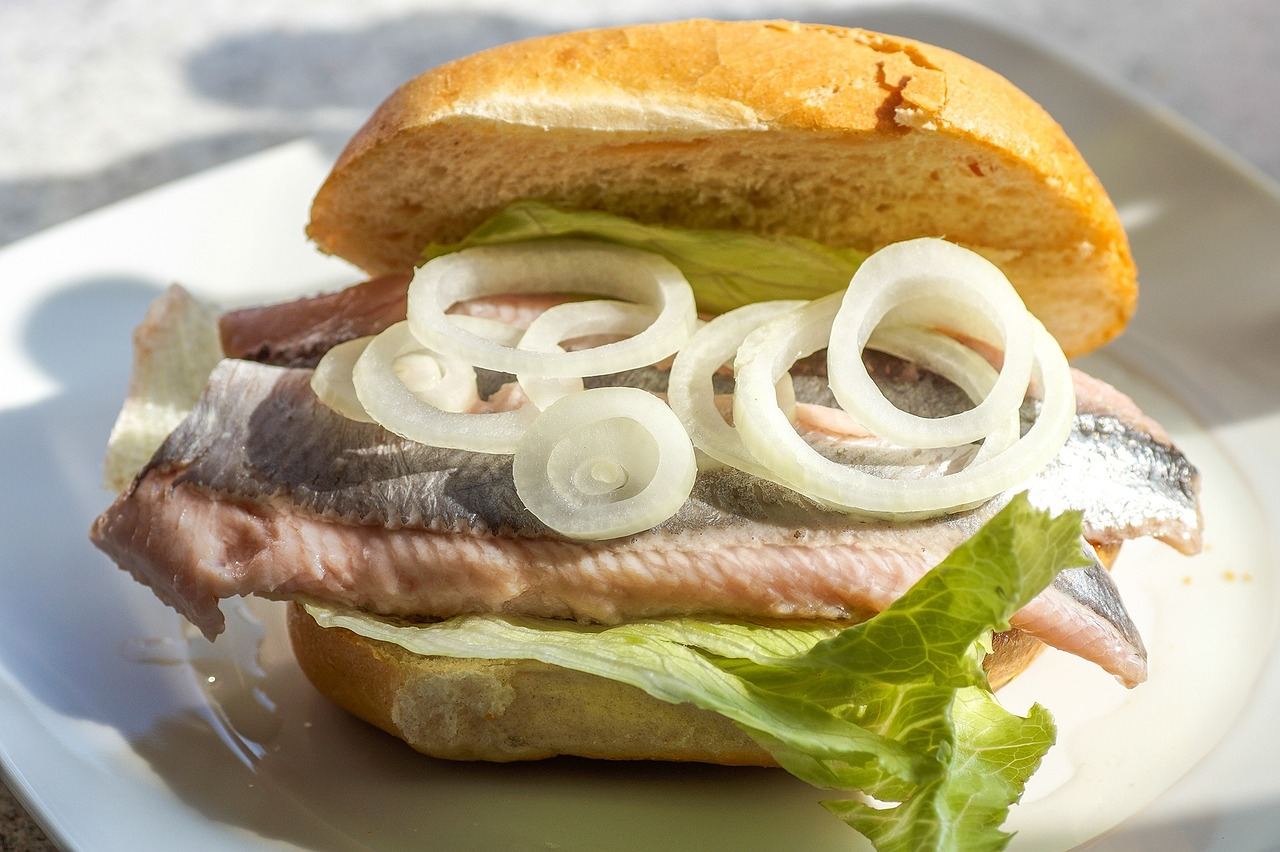
Serving styles from the Netherlands, Germany and Sweden
Each region has its own habit, and all of them are worth borrowing:
- Netherlands: served as a snack, most frequently plain or with diced raw onion.
- Northern Germany: potatoes boiled in their skins, French beans, and finely sliced fried bacon and onion.
- Germany, bread roll: sliced raw onion in a roll, known as Matjesbrötchen.
- Holstein: on dark bread with a cowberry and cream sauce.
- Sweden: boiled potatoes, sour cream, chopped chives, crisp bread and snaps.
All of this comes from Wikipedia’s serving section. It adds that in the Netherlands the whole herring is often eaten by lifting it by the tail and eating it upwards.
For another take on fish in a roll, see the fischbrötchen recipe.
If you want the vinegar-pickled style instead, the rollmops recipe is the place to look, since raw herring pickled in vinegar is called rollmops.
Pairing ideas for your table
Think in layers: something starchy, something creamy, something sharp. Matjes is fatty and mild, so each layer has a job.
- Starch: boiled potatoes, dark bread or crisp bread.
- Creamy: sour cream, or cream or yogurt sauces with onions and gherkins.
- Sharp: raw onion, pickles and gherkins.
- Extras: boiled eggs, chopped chives, French beans, or a herring salad.
- Sweet-tart: a cowberry and cream sauce on dark bread, as served in Holstein.
Wikipedia notes that soused herring is also served in salads and that boiled eggs are popular with the Swedish plate, per its serving notes. Snaps belongs to the Swedish version, so add it if you want to follow that tradition.
A practical rule: if the plate feels heavy, add more onion or gherkin. If it feels sharp, add potatoes or a creamy sauce.
Frequently asked questions
Do I need to soak matjes before eating it?
Show answer
No, soused herring does not need soaking. Wikipedia says salt herrings, with a salt content of 20%, must be soaked, so check which type you have; see the soused herring entry.
Is matjes raw?
Show answer
It is not cooked. A Dutch wholesaler’s guide says herring is often thought of as raw fish, but it is aged in brine. The Wikipedia soused herring entry puts the brining at approximately five days.
When can I buy Hollandse Nieuwe?
Show answer
The EU specification says the name may be used for product sold between 1 May and 30 September of the same calendar year. After that, the herring can still be sold as Hollandse maatjesharing, per the specification.
What do I serve with matjes?
Show answer
Potatoes boiled in their skins, raw onion and pickles are the classic start. Add French beans and fried bacon for a northern German plate, or sour cream, chives and crisp bread for the Swedish style, as described on Wikipedia.
Is the name Hollandse maatjesharing protected?
Show answer
As of the GOV.UK entry published 4 January 2021, it is registered as a Traditional Speciality Guaranteed. See the GOV.UK page, and check it for any later change.