

Standing at the fish counter unsure what to trust? Here is how to tell if fish is fresh: look for clear, full eyes, red gills, firm springy flesh and a mild, clean smell.
Once you have picked good fish, you will find more ideas among the seafood recipes on this site.
| Check | What good looks like |
|---|---|
| Eyes (whole fish) | Bright, clear, full, often protruding |
| Gills | Bright red or pink |
| Flesh | Firm yet elastic, springing back when pressed gently |
| Display temperature | As near to 32°F as possible |
| Fridge storage at home | Use within one to two days |
| Cooked fish | 145 °F internal temperature |
The figures come from Oregon State University’s seafood handling guide and Clemson’s safe handling of fish factsheet. Guidance can change, so check the source before you rely on the figures.
Start with the display, not the fish
Freshness starts before you pick anything up. Clemson’s factsheet says fish should lie on a thick bed of fresh ice that is not melting, preferably in a case or under a cover (Clemson).
Oregon State’s guide adds that all fresh seafood should be held as near to 32°F as possible, using refrigeration and/or ice (Oregon State). A warm, wet or messy counter is a reason to walk away.
These signs point to a counter worth buying from:
- Fish on a thick bed of fresh, not melting, ice.
- Fish arranged with the bellies down, so melting ice drains away from the flesh.
- A case or cover over the display.
- A seller with a known record of safe handling, rather than a roadside stand.
Seafood is highly perishable, so the same guide suggests you buy it last on a shopping trip.
Whole fish: eyes, gills, skin and flesh
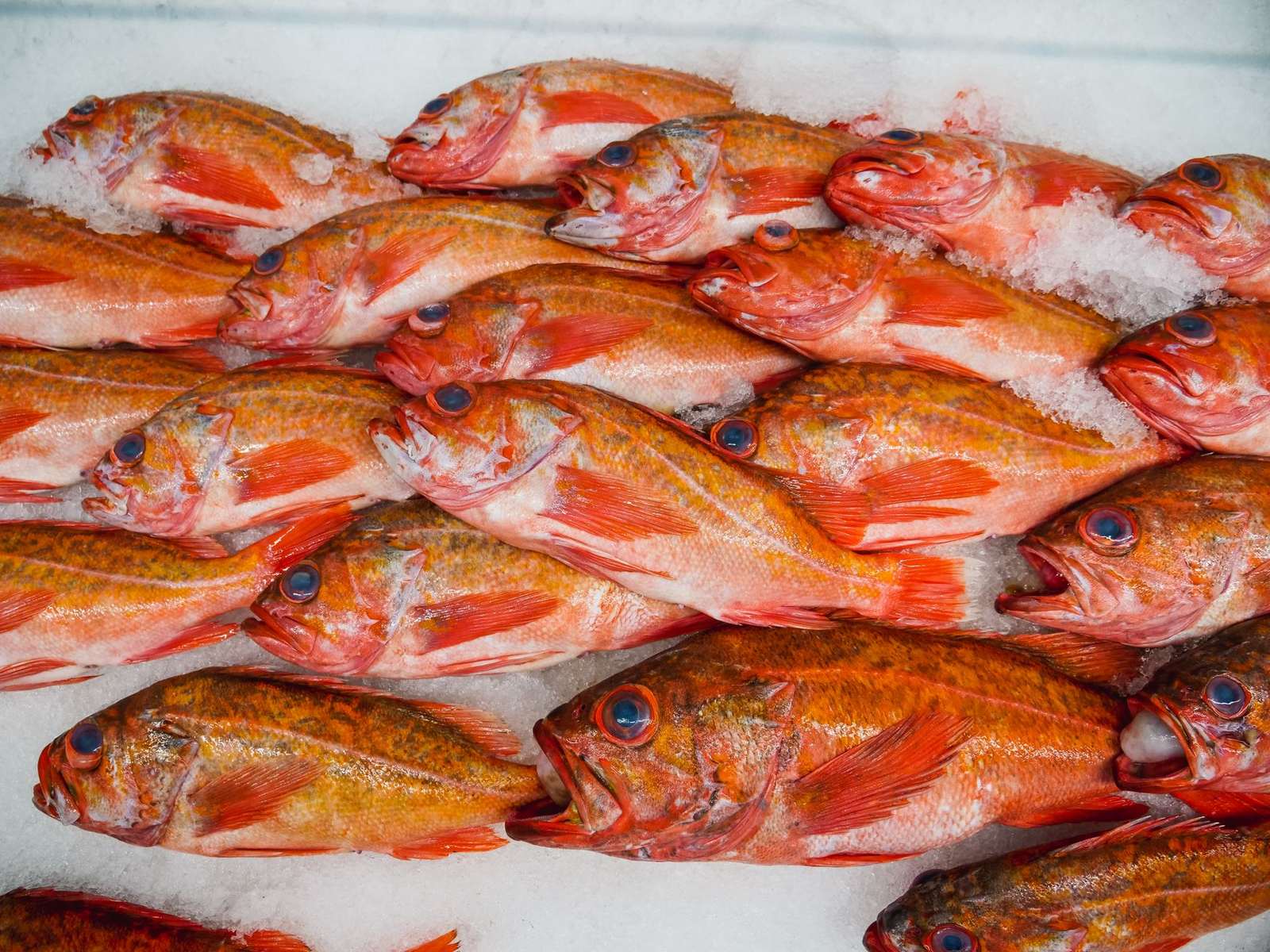
A whole fish gives you the most to inspect, and a fishmonger quoted on a kitchen-appliance site says he prefers buying whole fish for exactly that reason (The Neff Kitchen). Use your eyes, hands and nose, in that order.
- Eyes: bright, clear and full, often protruding. As freshness drops they turn cloudy, pink and sunken.
- Gills: bright red or pink. Avoid dull gills that are gray, brown or green.
- Skin: shiny, with scales that stick tightly. Loose or missing scales point to age or temperature abuse.
- Flesh: firm yet elastic, springing back when you press gently with a finger. With time it turns soft and slips away from the bone.
- Feel: cold, not cool, to the touch.
The Neff Kitchen’s fishmonger notes that gills are bright red when a fish is first caught and darken slowly, so the brighter the colour, the fresher the fish. Clemson describes the fade as light pink, then gray, and finally greenish or dull brown (Clemson).
When cloudy eyes are not a warning
The eye rule has exceptions. Clemson says it does not always apply to small-eyed fish such as salmon (Clemson).
The Neff Kitchen’s fishmonger adds that barramundi, kingfish and mackerel can look slightly cloudy even when spanking fresh, so for those species look for plump, wet and shiny eyes instead (The Neff Kitchen).
A note on slime
Slime is a mixed signal, so read it carefully. Oregon State says fresh fish should be free of loose or sloughing slime, while the fishmonger quoted by The Neff Kitchen describes a clean, translucent sheen on the outside (Oregon State, The Neff Kitchen). A thin, clear film is fine; thick, stringy or cloudy coating is not.
Smell: what fresh fish should and should not give off
Your nose is the fastest test. Oregon State says the odor of fresh fish should be that of a fresh sea breeze, and the fishmonger quoted by The Neff Kitchen compares it to mineral water or even cucumbers (Oregon State, The Neff Kitchen).
Walk away if you notice any of these:
- A fishy odor that is strong or objectionable.
- A sour smell.
- An ammonia-like smell.
- An earthy, swamp-water smell.
A HealthDay tip published in August 2016 passed on the FDA’s advice to check that there is no fishy, sour or ammonia-like odor (HealthDay). Cooking does not rescue a bad smell: the fishmonger quoted by The Neff Kitchen says it is more likely to enhance it (The Neff Kitchen).
Fillets, steaks and packaged fish
With no eyes or gills to inspect, you rely on the flesh and the edges. Oregon State says fillets and steaks should have firm, elastic flesh and a fresh-cut, moist appearance, with no browning around the edges (Oregon State).
- The flesh looks moist and firm, not dry or darkened at the edges.
- The smell is fresh and mild.
- The pieces hold together; fillets separate if they are left too long in the case.
- Packaged pieces are tightly wrapped, with no liquid and little or no air inside.
Clemson lists the same traits, and the HealthDay summary of FDA advice also says to avoid signs of darkening or dryness at the edges (Clemson, HealthDay). If you can, ask the fishmonger to fillet the fish dry, without immersing it in fresh water, as suggested by The Neff Kitchen’s fishmonger (The Neff Kitchen).
Is frozen fish a worse choice?
Not necessarily. Oregon State explains that the word “fresh” refers to seafood that has not been frozen, yet frozen seafood can be superior in quality to fresh, so you should base your purchase on product quality (Oregon State).
A tired fish that has sat on a counter for days can be worse than a good frozen fillet. Judge both by the same signs: appearance, smell and condition of the packaging.
If you buy frozen fish, do not refreeze it after thawing, because Clemson says the quality will suffer (Clemson).
After you buy: keep it cold and cook it well
Good fish loses its edge fast if it gets warm. Clemson recommends a fridge between 32 to 38 °F, storing fish in its original wrapper in the coldest part, and using it within one to two days, or freezing it (Clemson).
- Pick up fish last and keep it cold on the way home, in a cooler or packed in ice if the trip is long.
- Put it in the coldest part of the fridge in its original wrapper.
- Cook it or freeze it within one to two days.
- Cook until it reaches an internal temperature of 145 °F, which the FDA suggests as of Clemson’s factsheet revised in January 2020 (Clemson).
Once your fish passes every check, try it with a tangy sea buckthorn sauce for fish. For a Baltic-style street-food bite, the fischbrötchen recipe is a good place to start.
Frequently asked questions
Can fish still be fresh if its eyes look slightly cloudy?
Show answer
Sometimes. Clemson says the eye rule does not always apply to small-eyed fish such as salmon, and The Neff Kitchen’s fishmonger says barramundi, kingfish and mackerel can look slightly cloudy while fresh. Check the gills, smell and flesh too.
Should fresh fish smell fishy?
Show answer
It should smell mild. Clemson says the fishy odor develops with time and should not be strong or objectionable, and the FDA advice reported by HealthDay says to avoid fishy, sour or ammonia-like smells.
Does cooking remove a bad smell from fish?
Show answer
No. The fishmonger quoted by The Neff Kitchen says cooking will not remove strong earthy, ammonia or fishy odours and is more likely to enhance them, so do not buy fish that smells wrong.
How long can I keep fresh fish in the fridge?
Show answer
Clemson advises using fresh fish within one to two days, and freezing it if you cannot. Keep it in its original wrapper in the coldest part of the fridge.