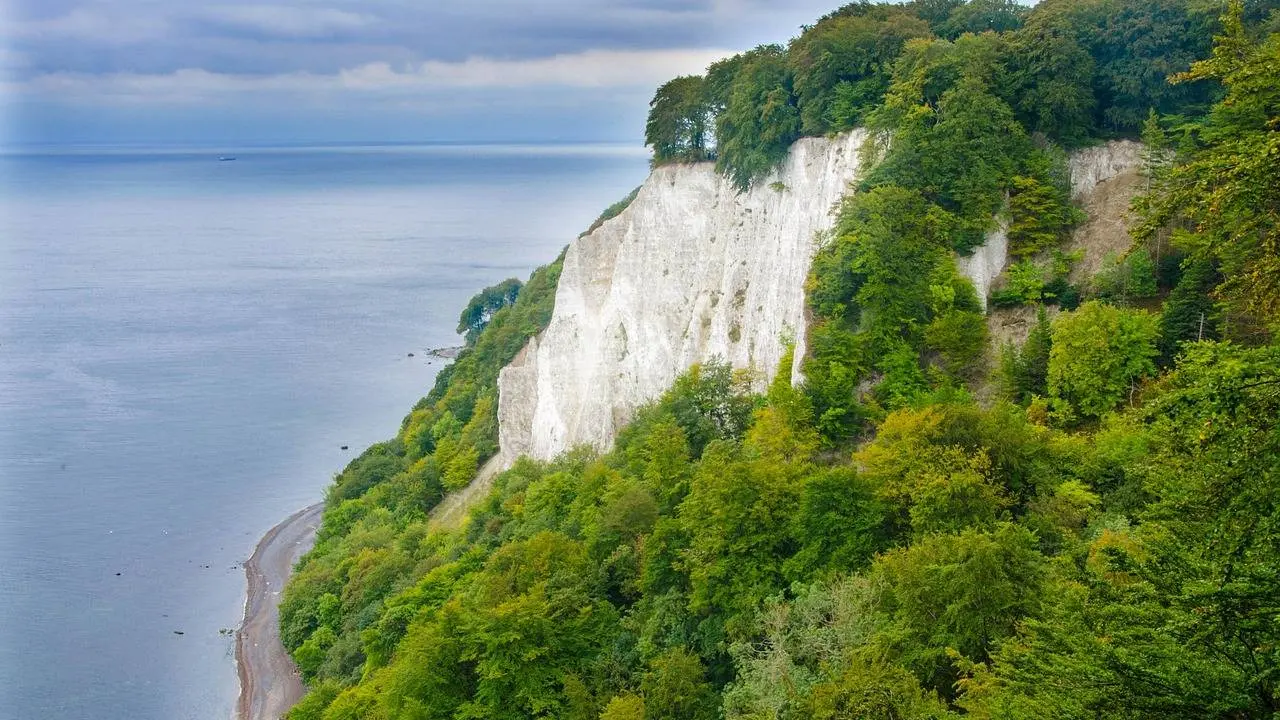
Planning to see the Jasmund National Park chalk cliffs and not sure how? Walk the coast on foot, never climb the cliff faces, and head for the 118 m Königsstuhl.
Planning more of the island? The rügen travel guide sets this walk in the wider picture of Rügen.
| Item | Value |
|---|---|
| Königsstuhl height | 118 m (387 ft) above the Baltic Sea |
| Park area | 30 km² (12 sq mi) |
| Park established | 12 September 1990 |
| Beech forest added to the UNESCO World Heritage List | 25 June 2011 |
| Königsstuhl National Park Centre adult ticket | €12 (as reported in November 2023) |
The figures come from Wikipedia’s Jasmund National Park page and a Kaiserslautern American article from November 2023. They can change, so check the sources before you rely on them, especially ticket prices.
What the Jasmund chalk cliffs are
Jasmund National Park is a nature reserve on the Jasmund peninsula, in the northeast of Rügen island in Mecklenburg-Vorpommern. It is famous for the largest chalk cliffs in Germany, and the highest of them, the Königsstuhl (“king’s chair”), rises to 118 m (387 ft) above the Baltic Sea, according to Wikipedia’s park page.
Wikipedia lists the park’s area as 30 km² (12 sq mi). The park was established on 12 September 1990, by the last East German government before reunification. In a November 2023 article, the Kaiserslautern American called Jasmund Germany’s smallest national park.
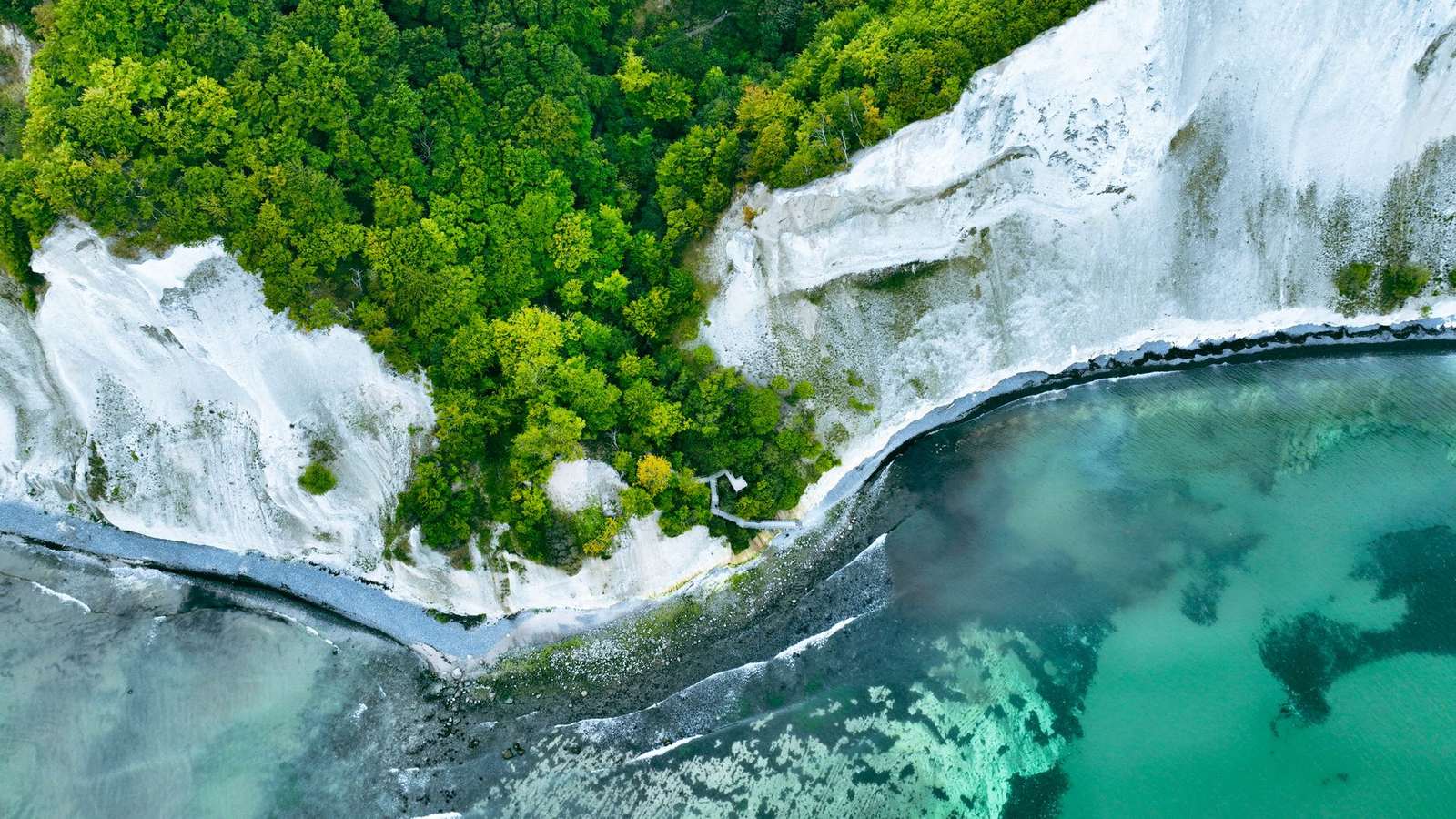
These cliffs are not static. They belong to the Rügen Chalk unit and face constant erosion, so parts fall with every storm, bringing down rocks and fossils of sponges, oysters and sea urchins. The Wissower Klinken, one of the best-known outcrops, collapsed into the Baltic Sea on 24 February 2005 in a landslide caused by spring-thaw weather, as Wikipedia records.
A heritage-route page from the University of Gdańsk describes the cliffs as ten kilometres long, a mix of active and inactive sections that show how coastal erosion works. It gives their height as up to 117 metres, a little off the Wikipedia figure, so treat any exact height as approximate. The same University of Gdańsk page says the Königsstuhl was immortalised by the painter Caspar David Friedrich.
Getting there and walking the coast
The area itself can only be entered on foot, according to Birdingplaces. Buses run only as far as the National Park Center, and if you arrive by car you can park close to it.
From there you can make a circular walk or simply follow the coastline. The route on the Birdingplaces map is the coastal walk, 7 km one way, so plan time for the return leg as well. That page was last updated on 6 November 2024, per its own listing.
Birdingplaces describes the ground in three ways:
- The route is an unpaved road and a narrow trail.
- Conditions are hilly and rocky.
- The walk is rated as an average walk, reached on foot.
Because the ground is unpaved and rocky, sturdy shoes are a sensible choice, and so is leaving yourself some daylight at the end.
The park includes the Stubnitz ridge north of the city of Sassnitz, according to Wikipedia, so that town is a handy reference point on the map. The Kaiserslautern American also suggests a nearby village such as Sassnitz for a long weekend.
Rules and safety on the cliffs
As of the Kaiserslautern American’s November 2023 article, it is forbidden to climb the cliffs. The article gives visitor safety, because the faces are very steep, and conservation, because chalk does not hold up to human feet as well as granite.
Falling rock is the other risk. The same source warns that chalk is not the most stable material, and Wikipedia notes that parts of the cliffs come down with every storm, so be careful on the beach below the faces.
A short checklist for the day:
- Stay off the cliff faces and out of any climbing.
- Watch for falling rocks above you, especially after storms.
- Wear sturdy shoes for rocky, unpaved ground.
Beech forest and wildlife behind the cliffs
Behind the cliffs, the Stubnitz ridge is covered with primeval beech forest. On 25 June 2011 the beech forest was added to the UNESCO World Heritage List as an extension of the Primeval Beech Forests of Europe site, because of its undisturbed nature, Wikipedia says.
The woods hold numerous water-filled dells and hollows, most of which began as ice-age dead-ice holes. Plants named on the Wikipedia page include black alder, European crab apple, wild service tree, yew and orchids.
Wikipedia also lists the birds that live in the park:
- White-tailed eagles
- Common kingfishers
- House martins
- Peregrine falcons
For birders, Birdingplaces says the peregrine falcon breeds on the chalk cliffs and that Black Woodpecker can be seen in the forest. It adds that Red-breasted Flycatcher and Greenish Warbler are regularly observed rarities, and that Northern Gannet have been seen frequently in front of the cliffs for some time.
The Königsstuhl centre and nearby stops
The Königsstuhl National Park Centre opened in March 2004, according to Wikipedia. One of the park authority’s main tasks is to keep the diverse habitats largely undisturbed while still giving visitors an insight into the region’s nature.
The Kaiserslautern American describes exhibitions on the park’s history, geology and ecology, plus a newly built Skywalk. As of its November 2023 article, the centre is one of the few places in the park that charges admission:
- Adults: €12
- Children aged 6-14: €6
- Children 5 and under: free
- Family ticket: €25
The highest point in the whole park is not the Königsstuhl but Piekberg, at 161 m (528 ft) above sea level, per Wikipedia. If you like geology, the same Kaiserslautern American piece points to the Rügen Chalk Museum at the western edge of the park and notes that it is closed for most of January.
The University of Gdańsk page places the Granitz Hunting Lodge south of Binz, and the things to do in binz are worth a look if you stay in that resort. The same page also lists Rügen’s narrow-gauge steam railway, the Racing Roland, as a cultural attraction, so read up on the rasender roland steam railway if you want a slower ride.
When is the best time to visit?
Birdingplaces lists the best time to visit as spring migration, autumn migration and spring, and calls the birding season good all year round. You can read the details on its Königsstuhl listing.
Winter is possible too. The Kaiserslautern American calls the park a place to explore all year round and describes standing above the Baltic Sea in late December as bracing but incredible. Dress for wind and watch the ground, since a storm is also when the cliffs shed rock.
Frequently asked questions
Can you climb the chalk cliffs?
Show answer
No. As of the Kaiserslautern American’s November 2023 article, climbing them is forbidden for safety and conservation reasons, as the article explains.
How high is the Königsstuhl?
Show answer
Wikipedia gives 118 m (387 ft) above the Baltic Sea, as stated on its park page.
Can you drive to the cliffs?
Show answer
You can drive and park close to the National Park Center, and buses also run that far. Beyond that point visitors continue on foot, as Birdingplaces notes.
Does the park charge an entry fee?
Show answer
The Königsstuhl centre is one of the few places in the park that charges, at €12 per adult as of the Kaiserslautern American’s November 2023 article. Check the current price before you go.